Astrophysics for People in a Hurry
Neil deGrasse Tyson's short, clear tour of the universe, written for readers with little time and lots of curiosity.
Published
26 October 2026
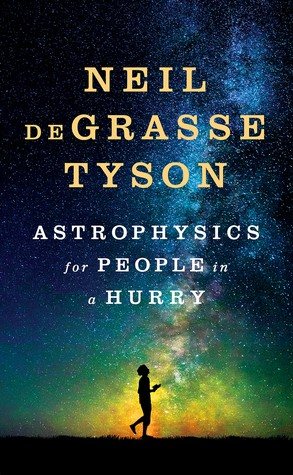
Astrophysics for People in a Hurry is exactly what its title promises. It is a small book of twelve short chapters, most of them adapted from essays Neil deGrasse Tyson wrote over many years for Natural History magazine, each one built around a single idea about the universe. Tyson, an astrophysicist and the director of the Hayden Planetarium at the American Museum of Natural History in New York, is best known as a broadcaster, and in 2014 he presented a new television version of Cosmos, picking up where Carl Sagan had left off. The book, published in 2017, carries the same spirit in a compressed form. It is written for people who are curious about the universe but busy, and it reads well in short sittings: on a train, in a waiting room, in the few minutes before sleep.
The first chapter attempts the most compressed story of all: the history of the universe from its first instant to the appearance of life on Earth, told in about a dozen pages. Tyson begins with the whole observable cosmos packed into a volume smaller than a pea, at a temperature of trillions of degrees, and follows it through expansion and cooling as the forces of nature separate, matter wins out narrowly over antimatter, nuclei form, atoms form, and gravity gathers matter into galaxies, stars and planets. The pace is breathless and the tone is playful. It works because Tyson keeps returning to the idea that connects the whole story to the reader: the elements in our bodies were forged in those stars, and the chain of events that led to us was not separate from the history of the universe but part of it.
The second chapter is, to my mind, the most important in the book, because it explains something that is easy to take for granted. The laws of physics that we measure in laboratories on Earth appear to work in exactly the same way throughout the universe. The spectrum of hydrogen in a distant galaxy shows the same pattern of lines as hydrogen in a glass tube. Gravity holds galaxies together by the same law that holds the Moon in orbit. Tyson tells the story of the element helium, which was first identified not on Earth but in the spectrum of the Sun, during a solar eclipse in 1868, and only later found here. The universality of physical law is what makes astrophysics possible at all. Without it, we could learn nothing about places we cannot visit.
Several chapters deal with light, which is almost the only messenger we receive from distant objects. Tyson explains how different kinds of light, from radio waves through visible light to X-rays and gamma rays, reveal different aspects of the universe, and how much of the sky’s story was invisible until telescopes were built to detect wavelengths our eyes cannot see. One chapter is devoted to the cosmic microwave background, the faint glow left over from the time when the young universe became transparent, roughly 380,000 years after the beginning, and which now fills all of space. Its discovery in 1965, and the detailed maps made of it since, are among the strongest pieces of evidence for the Big Bang.

The chapters on dark matter and dark energy are the most honest in the book. Most of the matter in the universe, Tyson explains, does not shine and cannot be seen. We know it is there because of its gravity: galaxies rotate too fast to be held together by their visible stars alone, and clusters of galaxies bend light from objects behind them more than their visible matter can account for. Dark energy is stranger still, a property of space itself, or something filling it, which is causing the expansion of the universe to accelerate. Together they make up roughly ninety-five per cent of everything, and nobody knows what either of them is. Tyson treats this not as an embarrassment but as the most exciting fact in modern astrophysics: a clear sign of how much remains to be found.
A lighter chapter, called “Cosmos on the Table”, walks through the periodic table of elements and describes where each kind of atom comes from: hydrogen and helium from the Big Bang, carbon, oxygen and the elements of life from the cores of stars, heavier elements such as gold from the violent deaths of massive stars and the collisions of their remnants. It makes concrete Sagan’s old line about being made of star-stuff. Other chapters consider why so many things in space are round, what lies in the apparently empty space between galaxies and between planets, and what Earth would look like to astronomers on a planet orbiting another star, with our radio broadcasts and the chemical signatures of our atmosphere giving us away.
The book ends with a reflection on what Tyson calls the cosmic perspective. Seeing ourselves as a small part of a vast and ancient universe, he argues, should make us humble and curious, and should make many of the divisions between people look small. It is the most personal chapter, and the most clearly in Sagan’s tradition. Some readers find it preachy, but it is a fitting end to a book whose aim is to change how the reader sees their place in things, not just to inform.
The book’s limits come with its form. Each chapter is short and simplifies a great deal, and some topics, such as inflation or the nature of quantum fields, are touched on so briefly that they raise more questions than they answer. The jokes do not always land. Readers who want depth will need to go on to longer books, many of which are on this shelf. But as a starting point it is excellent. Short does not have to mean shallow, and each chapter leaves the reader knowing something real and wanting to know more. For a book meant to be read in a hurry, that is a considerable achievement.
Ayoub Khallok keeps this archive of essays, research, lessons and notes, written to understand things more clearly. More about Ayoub.