A Brief History of Time
Stephen Hawking's tour of space, time, black holes and the origin of the universe, written for anyone curious enough to ask.
Published
26 October 2026
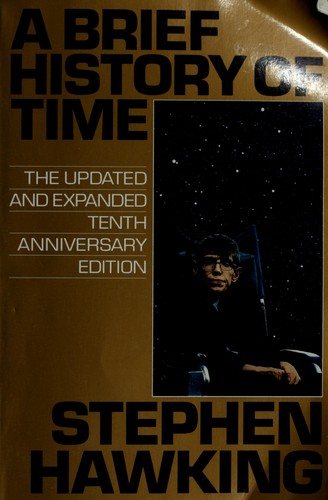
Stephen Hawking’s publisher gave him a piece of advice while he was writing A Brief History of Time: every equation in the book would halve its sales. Hawking took it seriously. The finished book contains exactly one, Einstein’s E = mc², and he admits in the acknowledgements that he hoped it would not frighten away half his potential readers. It did not. Published in 1988, the book stayed on the London Sunday Times bestseller list for more than four years and sold millions of copies in dozens of languages. It also became, famously, one of the most-bought and least-finished books of its time. Both facts say something true about it. It asks the largest questions there are, and it does not pretend the answers are easy.
The questions are the ones children ask and most adults stop asking: where did the universe come from, will it end, and why is it the way it is? Hawking begins not with the answers but with the history of the questions. The first chapter starts with a story he retells with obvious affection, about a scientist giving a public lecture on astronomy who is challenged afterwards by an elderly woman insisting that the world is really a flat plate resting on the back of a giant tortoise. Asked what the tortoise stands on, she replies that it is turtles all the way down. Hawking’s point is not to mock her. It is to ask what makes our own picture of the universe better than hers, and how we could tell.
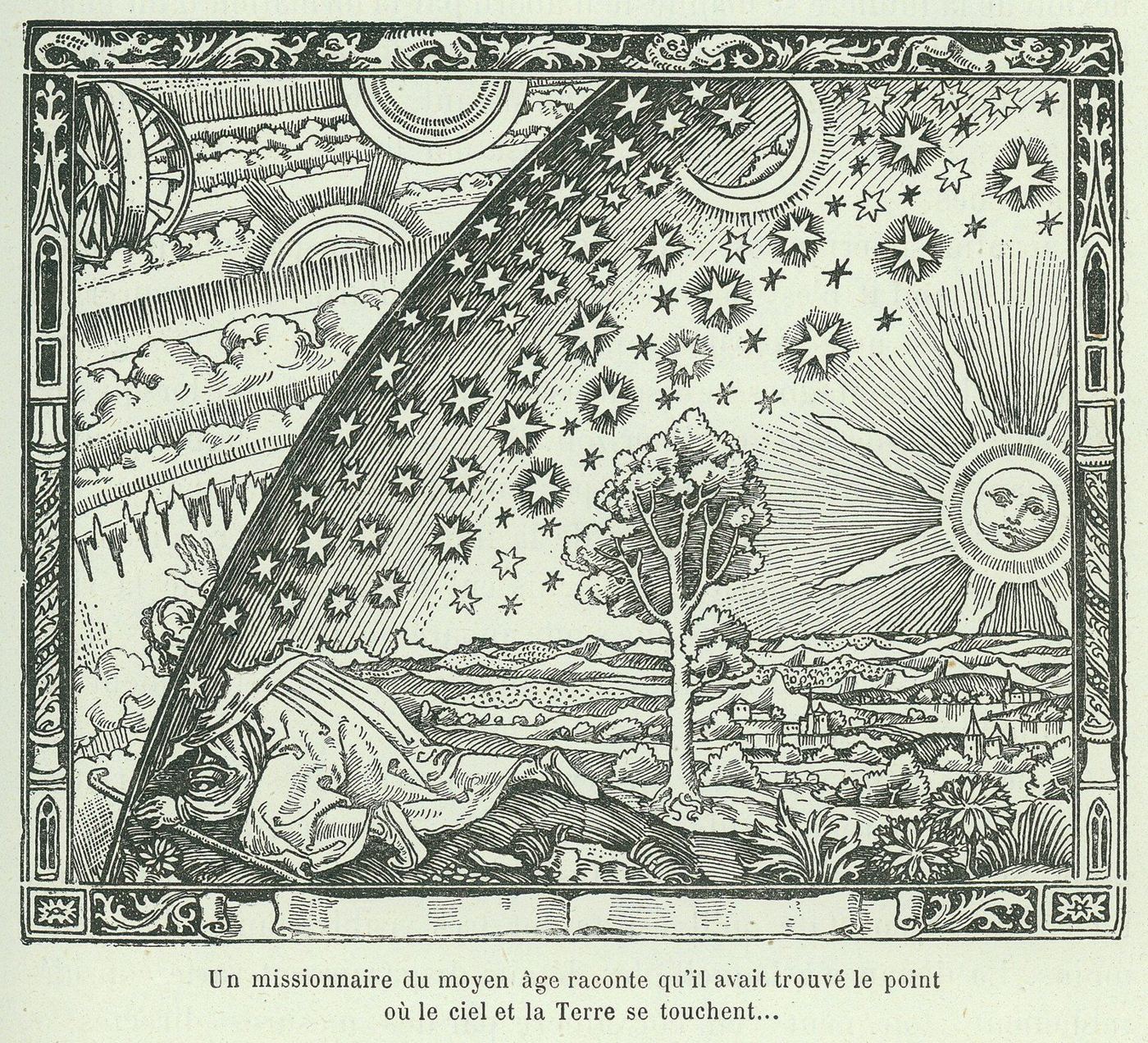
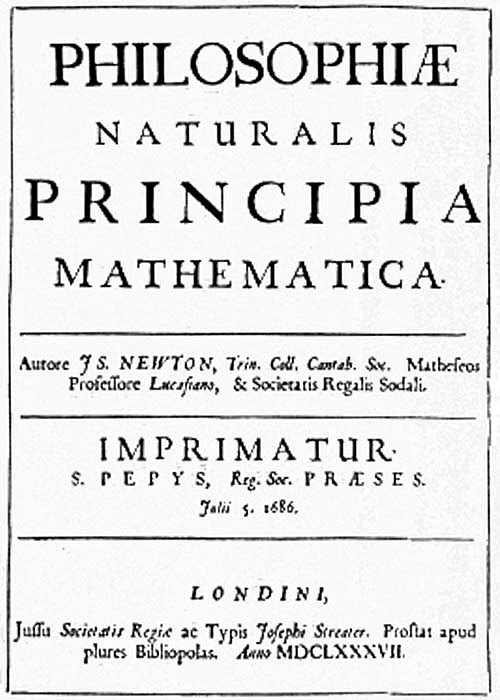
The answer he gives is a short account of how that picture has changed. Aristotle reasoned that the Earth was round from the curved shadow it casts on the Moon during an eclipse. Ptolemy built an elaborate model of nested spheres with the Earth at the centre, which predicted the positions of the planets well enough to be used for more than a thousand years. Copernicus moved the Sun to the middle; Galileo, turning a telescope to the sky, found moons circling Jupiter and showed that not everything revolved around us; Newton explained the motion of the planets and the fall of an apple with the same law of gravity. Each step made the universe larger and less centred on human beings, and each replaced a theory that had seemed perfectly adequate. Hawking uses this history to set out what a scientific theory is: a model that describes a large class of observations with a few elements and makes definite predictions about future ones. A theory can never be proved, only not yet disproved. It is a modest definition, and it frames everything that follows.
The chapters on space and time are the most demanding and the most rewarding. Newton’s universe had an absolute time, ticking at the same rate for everyone, and an absolute space against which motion could be measured. Einstein’s relativity dissolved both. The speed of light turns out to be the same for every observer, however they are moving, and the price of that constancy is that time and distance are not. Clocks moving relative to each other disagree; lengths contract; space and time are woven into a single four-dimensional fabric. General relativity goes further and makes gravity a property of that fabric: mass and energy curve space-time, and objects moving freely through it follow the curves. Hawking explains this with light cones and simple diagrams rather than equations, and while the ideas never become easy, they become clear enough to follow.
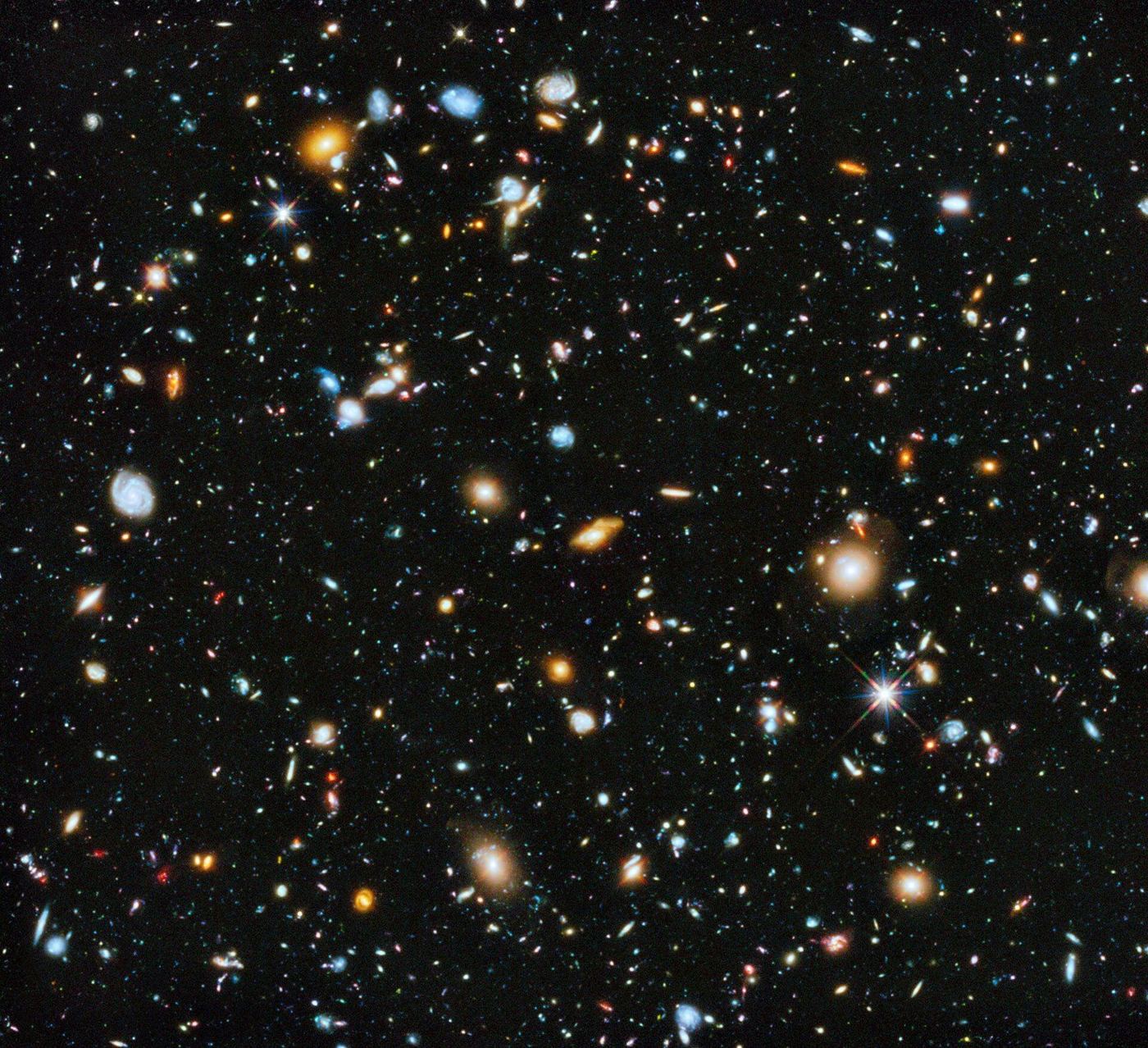
From there the book moves outwards, to the discovery that distant galaxies are rushing away from us and that the universe is expanding. If it is expanding now, it was smaller in the past, and at some finite time ago, everything we can observe must have been packed together at infinite density, a singularity at which the laws of physics break down. Hawking describes, with a scientist’s pride and a certain dryness, how he and Roger Penrose proved in the 1960s that, if general relativity is correct, such a singularity is unavoidable. It is a remarkable result, and also, as he goes on to admit, a sign that general relativity cannot be the whole story. At the smallest scales, the universe is governed by quantum mechanics, where the uncertainty principle forbids knowing both the position and the speed of a particle exactly, and where nature itself seems to deal in probabilities. Any theory of the very beginning must combine the two, and nobody yet knows how.
The heart of the book, and the part that is most clearly Hawking’s own, is about black holes. A massive enough star, at the end of its life, can collapse under its own gravity until not even light can escape from its surface. The boundary of that region, the event horizon, is a one-way membrane: things fall in and nothing comes out. Or so it seemed, until Hawking applied quantum theory to the region just outside the horizon and found, to his own surprise, that black holes should glow. Pairs of particles constantly appear and vanish in empty space; near a horizon, one member of a pair can fall in while the other escapes, so that the black hole slowly radiates energy and loses mass. Over immense periods, it should evaporate entirely. The effect has never been observed, because for black holes made from stars it is fantastically weak, but the calculation was one of the first to combine gravity and quantum mechanics in a meaningful way, and it has shaped theoretical physics ever since.
The later chapters become more speculative, and Hawking is careful, mostly, to say so. He describes the “no-boundary” proposal that he developed with James Hartle, in which the universe has no edge or beginning in time in the ordinary sense, in the same way that the surface of the Earth has no edge, and he is explicit that it is a proposal rather than a result. He discusses the arrow of time, why we remember the past and not the future, and connects it to the growth of disorder. And he ends with the search for a complete unified theory, one that would describe everything in the universe. If we found it, he writes in the book’s most famous line, it would be the ultimate triumph of human reason, for then we should know the mind of God. Hawking was not a believer, and the phrase is better read as a flourish than a confession, but it has been quoted, and misquoted, ever since.
Much of the book has aged well, and some of it has not. Physics has moved on since 1988. The discovery in the late 1990s that the expansion of the universe is accelerating, driven by something now called dark energy, does not appear. Black holes, which in 1988 were strongly suspected but not directly seen, have since been photographed and heard: the Event Horizon Telescope imaged the shadow of one in 2019, and gravitational-wave detectors have recorded many of them merging. Hawking himself later changed his mind on a question the book treats, whether information that falls into a black hole is truly lost. The no-boundary proposal remains one idea among several, and a unified theory seems, if anything, further away than the book’s final chapter implied.
None of that makes the book less worth reading. What it teaches is not a set of results but a way of approaching questions that seem too big to ask. Hawking shows that you do not need the equations to follow the shape of an argument, that the history of science is largely a history of corrections, and that the strangest places in the universe, black holes and the beginning of time, are where our best theories meet and test each other. It is a short book about the largest questions there are, and a standing argument that anyone curious enough is entitled to think about them.
Ayoub Khallok keeps this archive of essays, research, lessons and notes, written to understand things more clearly. More about Ayoub.