Cosmos
Carl Sagan's tour of the universe, and of the people who learned to understand it.
Published
25 October 2026
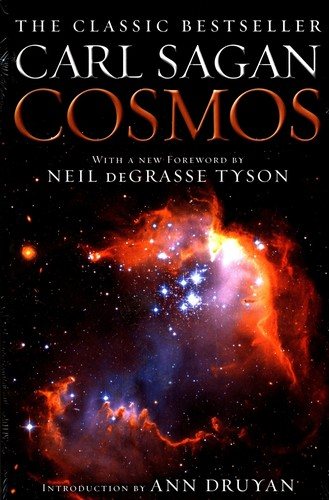
Cosmos opens with one of the best first lines in science writing: “The Cosmos is all that is or ever was or ever will be.” It is a grand sentence, and a risky one, because a book that begins at that scale has to earn it. Carl Sagan earns it by doing something unexpected. Instead of staying at the edge of the universe, he spends most of the book with people: an astronomer in Alexandria with a stick and a shadow, a mystic in Prague trying to fit the planets inside geometric solids, a team of engineers in California steering a spacecraft past Jupiter. The cosmos in the title turns out to include the long human effort to understand it.
The book was written in 1980 alongside the television series Cosmos: A Personal Voyage, and it follows the series’ thirteen episodes. That origin shows in its rhythm. Each chapter is a journey with a destination, and Sagan moves between scales and centuries with the ease of a narrator who knows the camera can follow. The first chapter starts in intergalactic space, among the hundred billion galaxies, and works inwards, past clusters, spiral arms and nebulae, until it reaches a single yellow star and the small blue planet that orbits it. Only then does it turn to the question of how anyone came to know any of this. The answer, for Sagan, begins on a June day in ancient Egypt.
Eratosthenes, the librarian of the great Library of Alexandria, had read that at noon on the summer solstice, in the southern town of Syene, a vertical stick cast no shadow and the sun shone straight down a deep well. In Alexandria, at the same moment, a stick did cast a shadow. If the Earth were flat, the sun’s rays would fall at the same angle everywhere. They did not, so the Earth was curved, and from the difference in angle and the distance between the two towns, Eratosthenes calculated its circumference. His answer was remarkably close to the modern value. Sagan tells this story slowly and with obvious delight, because it contains the whole method in miniature: notice something odd, take it seriously, measure it, and follow the reasoning wherever it goes. The tools were a stick, the eyes, and the brain, and, Sagan adds, a taste for experiment. With those, a man measured a planet.
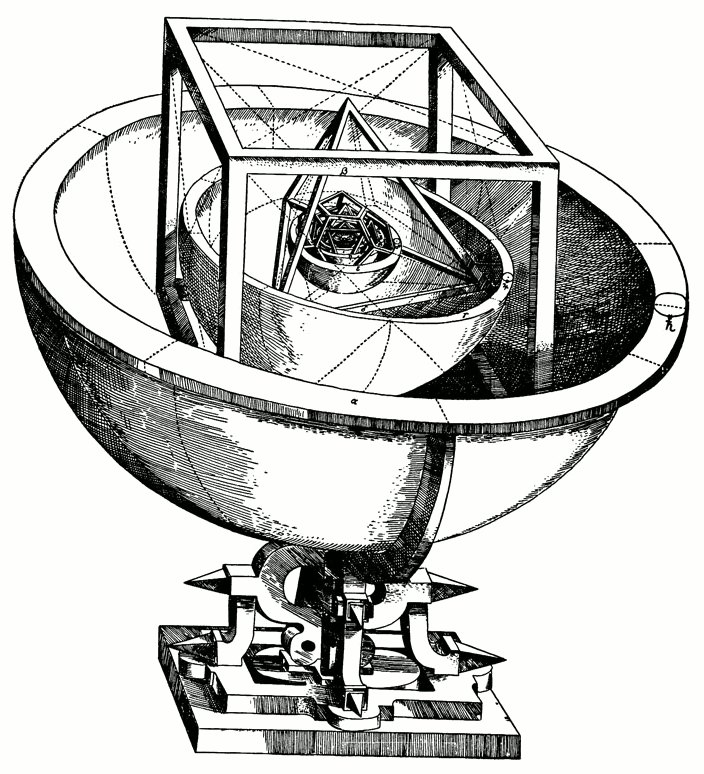
The story of Johannes Kepler, a few chapters later, is the book’s most moving portrait. Kepler began as a believer in a beautiful idea: that the distances of the six known planets from the Sun were set by the five perfect solids of Greek geometry, nested one inside another. He spent years trying to make it work. When he finally gained access to Tycho Brahe’s observations of Mars, the most precise measurements of the age, they disagreed with his circular orbits by a tiny amount, eight minutes of arc, a fraction of the width of the full Moon. A lesser thinker might have blamed the data. Kepler blamed his theory. The orbit, he eventually found, was an ellipse, and with that discovery he gave up the harmony he loved for the one the planets actually followed. Sagan treats this as the heart of science: the willingness to let a cherished idea go when the evidence says so, even when the evidence is eight minutes of arc.
Much of the book returns to a question that clearly mattered to Sagan personally: why did this way of thinking take so long to establish itself, and why was it so nearly lost? He celebrates the Ionian thinkers of the sixth century BCE, who tried to explain the world through natural causes rather than the whims of gods, and he mourns the Library of Alexandria, its scholars and its hundreds of thousands of scrolls, most of which did not survive. Historians have since questioned parts of his account, particularly the drama of the Library’s end and the death of the mathematician Hypatia, which he tells as a single tragic turning point. The real story was slower and more complicated. But his larger point stands on its own: knowledge is fragile, it depends on institutions that protect it, and it can be lost.
The chapters on life are among the most beautiful. Sagan describes evolution as a kind of cosmic fugue, a single theme developed over four billion years into countless variations, from self-copying molecules in the early oceans to the brains reading the page. He connects this to the life of stars. The carbon in our cells, the oxygen we breathe and the iron in our blood were made in earlier generations of stars and scattered into space when they died. “We are made of star-stuff” is the line everyone remembers, and the book explains, without exaggeration, why it is literally true. There is a related idea that runs through the whole text: that human beings are the part of the universe that has become able to look back at itself. Sagan puts it most simply when he says that we are a way for the cosmos to know itself.
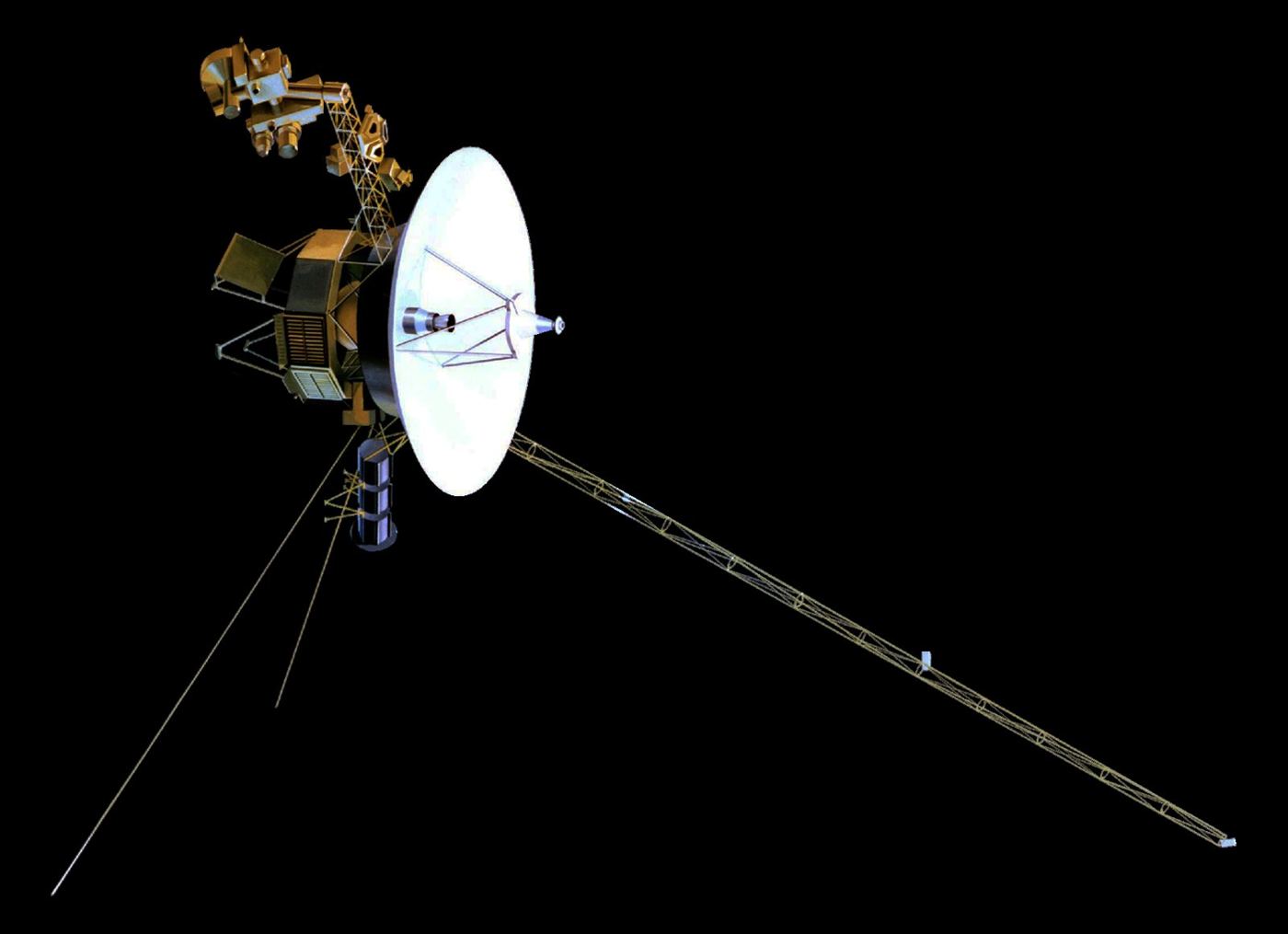
He was not only a writer. Sagan worked on the American planetary missions of the 1960s and 1970s, and the chapters on Mars, Venus and the outer planets have the excitement of someone reporting from inside the project. The Viking landers had just touched down on Mars; the Voyager probes were sending back the first close images of Jupiter’s moons and Saturn’s rings. Sagan describes the hellish surface of Venus, crushed under a thick atmosphere and heated by a runaway greenhouse effect, as a warning about what a planet’s air can do, decades before climate change became a public argument. He uses the Drake equation, which breaks the question of intelligent life elsewhere into a chain of smaller estimates, not to give an answer but to show how a seemingly impossible question can be made thinkable.
The last chapter is a plea, and it is easy to forget how serious it was. In 1980 the arsenals of the Cold War held tens of thousands of nuclear weapons. Sagan, who would later help develop the idea of nuclear winter, argues that a species clever enough to understand the cosmos is also clever enough to destroy itself, and that the outcome depends on whether science and reason are shared widely or kept as the property of a few. It is the most political part of the book, and also the most continuous with everything before it. The perspective of the first chapter, a small world among countless others, is offered as a reason for humility and for care.
Some of the science has, inevitably, dated. Cosmos was written before the discovery of planets around other stars, now numbering in the thousands, before dark energy, and before the missions that have since mapped Mars, landed on a comet and flown past Pluto. Some figures have changed, and a few historical stories have been complicated by later research. That makes the book a companion to newer ones rather than a replacement for them. What has not dated at all is the way of thinking it teaches. Sagan shows again and again that wonder and rigour are not rivals. The more carefully you look, the more astonishing the universe becomes, and the people who looked most carefully, Eratosthenes with his shadow and Kepler with his eight minutes, are the heroes of the story.
It is not the most up-to-date account of the universe, and it does not pretend to be neutral; it is openly a personal voyage. But it treats curiosity as something close to a moral virtue, and it makes the history of discovery feel like an inheritance that each reader is invited to take up. Few books manage to be both this ambitious and this kind.
Ayoub Khallok keeps this archive of essays, research, lessons and notes, written to understand things more clearly. More about Ayoub.